



Wprowadzenie produktów
| SODIUM TETRAFLUOROBORATE;SODIUM FLUOBORATE;SODIUM FLUOROBORATE;SODIUM BOROFLUORIDE;apretonr;Borate(1-),tetrafluoro-,sodium;boronsodiumfluoride(bnaf4);sodiumborontetrafluoride | |
| 13755-29-8 | |
| BF4Na | |
| 109.79 | |
| 237-340-6 | |
| Fluoride;resin finishing catalyst in printing;Inorganic Chemicals;Inorganics;halometallate salts;bc0001 | |
| 13755-29-8.mol | |
 |
|
| 384 degree | |
| 2.47 g/mL at 25 degree (lit.) | |
| 2.47 | |
| 108 g/100 mL (26 ºC) | |
| 14,8617 | |
| ACGIH: TWA 2.5 mg/m3 NIOSH: IDLH 250 mg/m3; TWA 2.5 mg/m3 |
|
| 13755-29-8(CAS DataBase Reference) | |
| Borate(1-), tetrafluoro-, sodium (13755-29-8) |
| 34 | |
| 45-36/37/39-25-26 | |
| 3260 | |
| 1 | |
| ED2975000 | |
| F | 21 |
| 2826 90 80 |
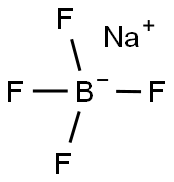
| Sodium tetrafluoroborate is an organic compound that has the molecular formula NaBF4. The compound is a salt that forms white or colorless water-soluble rhombic crystals. It is less soluble in organic solvents and readily soluble in water. | |
NaOH + HBF4 → NaBF4 + H2O Na2CO3 + 2 HBF4 → 2 NaBF4 + H2O + CO2 |
|
| Sodium tetrafluoroborate can be used as a catalyst for the synthesis of bis(indolyl)methanes via electrophilic substitution reaction of indoles with ketones and aldehydes. In the synthesis of ionic liquids such as trihexyl(tetradecyl)phosphonium tetrafluoroborat and 1-butyl-3-methylimidazolium tetrafluoroborate. In the laboratory, sodium tetrafluoroborate may be used for the synthesis of boron fluoride. It may also be used in the synthesis of fluoroheterocyclic and fluoro-nucleic acids. The compound is also used in metal finishing, fluxes, and plating circuits. |
|
| white crystals or powder, crystallizes in the anhydrous form as clear, orthogonal, stubby prisms. Anhydrous NaBF4 does not etch glass. Readily soluble in water. Rhombic crystals, isodimorphous with NaClO4. | |
| Fluorinating agent, see Lawton, Levy, J. Am. Chem. Soc. 77, 6083 (1955). | |
| Sodium tetrafluoroborate may be used for the laboratory synthesis of boron fluoride. It may be used for the synthesis of fluoro-nucleic acids and fluoroheterocyclic compounds. | |
| 4 | |
| Moderately toxic by subcutaneous route. When heated to decomposition it emits toxic fumes of Fand Na2O. | |
| Boric acid (6.2 g.) is added, with cooling, to 25 g. of 40% hydrofluoric acid contained in a Pt dish. The mixture is left standing for six hours at room temperature, then cooled with ice, and 5.3 g of dry Na2CO3 is added. The solution is then evaporated until crystallization starts. The salt can be recrystallized from water, whereby large, beautiful single crystals can be obtained. The NaBF4 is finally dried under vacuum. 2 H3BO3 + 8 HF + Na2CO3=2 NaBF4 + 7 H2O + CO2 |
|
| Crystallise the fluoroborate from hot water (50mL/g) by cooling to 0o. Alternatively, free it from insoluble material by dissolving it in a minimum amount of water; then fluoride ions are removed by adding concentrated lanthanum nitrate in excess. After removing lanthanum fluoride by centrifugation, the supernatant is passed through a cation-exchange column (Dowex 50, Na+-form) to remove any remaining lanthanum [Anbar & Guttman J Phys Chem 64 1896 1960]. It has also been recrystallised from anhydrous MeOH and dried in a vacuum at 70o for 16hours. Keep it dry as it is hygrosopic. [Delville et al. J Am Chem Soc 109 7293 1987.] |
| Ethanol-->Sodium carbonate-->Hydrogen fluoride-->Fluoroboric acid-->Tin-->Orthoboric acid-->Hexafluorosilicic acid-->Tin fluoroborate-->DECABORANE-->Diborane-->1,4-Difluorobenzene | |
| 2-Chloro-6-fluorophenylacetic acid-->METHYL 2-CHLORO-6-FLUOROPHENYLACETATE-->2-METHYLSULFANYL-PYRIMIDINE-5-CARBALDEHYDE-->2-Ethylpyrimidine-5-carbaldehyde-->2-METHOXY-PYRIMIDINE-5-CARBALDEHYDE-->1-Butyl-3-methylimidazolium tetrafluoroborate-->1-Ethyl-3-methylimidazolium tetrafluoroborate-->Boron trifluoride-->1,2-Dinitrobenzene-->Tetraethylammonium tetrafluoroborate-->1-ChloroMethyl-4-fluoro-1,4-diazoniabicyclo[2.2.2]octane bis(tetrafluoroborate)-->TRIPHENYLFLUOROSILANE-->1,2-Benzisothiazole,7-fluoro-(9CI)-->Borate(1-), tetrakis(3-Methoxyphenyl)-, sodiuM(9CI)-->SODIUM TETRA(P-TOLYL)BORATE |
Popularne Tagi:
Para: Fluorek magnezu
Następny: Fluoroboran amonu
Może ci się spodobać również
Wyślij zapytanie
